
If you have been on the tarmac or in the hangar during unscheduled maintenance,AOG(Aircraft On Ground), you know perfectly well that time does not forgive. The pressure to release the aircraft is immense, but the responsibility to ensure a safe flight is absolute. In the aerospace industry, visual inspection of aircraft engines is the first and most critical line of defense against catastrophic failures.
Nowadays, speed and accuracy are no longer isolated concepts. Trying to assess the condition of turbine blades or the combustion chamber with outdated equipment is like playing guessing games with safety and profitability. AtZION NDTwe know that in aviation maintenance, it means having no technical doubt when evaluating a microscopic crack. Therefore, we will address how new technologies inremote inspectionare redefining reliability standards in the industry.
The evolution of non-destructive testing in aviation
Remote visual inspection (RVI) has evolved from being just a simple camera connected to a monitor. Modern industrial videoscopes are true portable diagnostic technology that integrates advanced optical physics and digital image processing.
Unlike other Non-Destructive Testing (NDT) methods, visual inspection is the only one that allows us to interact face-to-face with the internal geometry of the engine without the need for costly disassembly.
Strict compliance
with international regulations
Both in the maintenance bases of commercial airlines and in the dynamic aerospace cluster in Querétaro, regulatory compliance is the universal language. The use of high-resolution equipment helps Level II and III inspectors meet the demanding standards of the FAA (Federal Aviation Administration) and EASA (European Union Aviation Safety Agency), which are rigorously audited and required at the national level by the AFAC (Federal Civil Aviation Agency), as well as with the visual evaluation requirements stipulated in the corresponding regulatory documents and the specific directives of engine manufacturers (OEM).
Real use cases:
Where NDT makes a difference
The level of demand we see in the aerospace sector shares similarities with other critical industries in Mexico. Just as an inspection team cannot fail in the face of corrosion on Oil & Gas platforms in the Gulf of Mexico, or in the casting lines of the automotive industry in Bajío, in aviation, industrial videoscopes excel in:
Detection of defects in turbines and compressors:Identification of impacts from foreign objects (FOD), erosion on leading edges, and thermal cracks in the blades.
Combustion chamber evaluation:Detection of thermal fatigue, injector blockage, or degradation of the ceramic coating.
Strategic and competitive advantages
By integrating an advanced system like theIPLEX NX, reliability engineers gain advantages that directly impact the reduction of operational costs:
Swoptix™ Multiview Technology (Zero Retracts):This is the real game changer in aerospace inspection. Swoptix technology allows you to instantly switch between close and far focus, or between direct and side view, without having to remove the probe from the engine to change the tip adapters. This drastically reduces inspection time and minimizes the risk of tips getting stuck or damaged inside the compressor blades.
Edge-to-edge clarity on a 10-inch screen:The interior of a turbofan demands the best lighting and sharpness.IPLEX Oneprovides high-resolution real-time images that cover the entire screen. Its 10-inch touchscreen features an anti-reflective coating and high contrast, allowing for much faster defect identification and accurate decisions, even under direct sunlight on the runway.
Wireless freedom and software scalability:Forget about rigid equipment that hinders ergonomics in tight spaces. TheIPLEX Onefeatures ultra-low latency communication that eliminates the need for wired setups, allowing the system to be operated remotely via its wireless remote control unit. Additionally, being a software-driven platform, you can start with basic functions and unlock advanced capabilities.
How does Swoptix™ 3D measurement and monocular modeling work in the IPLEX™ One?
The technical foundation: Goodbye to mandatory stereo tips Unlike traditional systems, theIPLEX Oneintroduces monocular 3D modeling powered by the exclusive software3DAssist. Through advanced algorithms in the internal computer processing, the videoscope reconstructs a three-dimensional topographic map of the inspected area from a single optical path, eliminating the need to remove the equipment to place a specific measurement stereo lens (tip).
In operational practice, this transforms your workflow in the hangar and removes ambiguity when determining:
- Full-Screen Measurement (Single-Screen):With Swoptix 3D technology, you can perform precise full-frame measurements of 4 mm and 6 mm instantly. You have a 120° field of view on a single screen that allows you to locate the defect and execute a reliable measurement without losing visual context.
- Split-Screen Analysis (Split-Screen):When you find a complex dent or crack, the interface allows you to make side-by-side visual comparisons. The screen shows you the traditional image alongside a manipulable 3D model with measurement overlays.
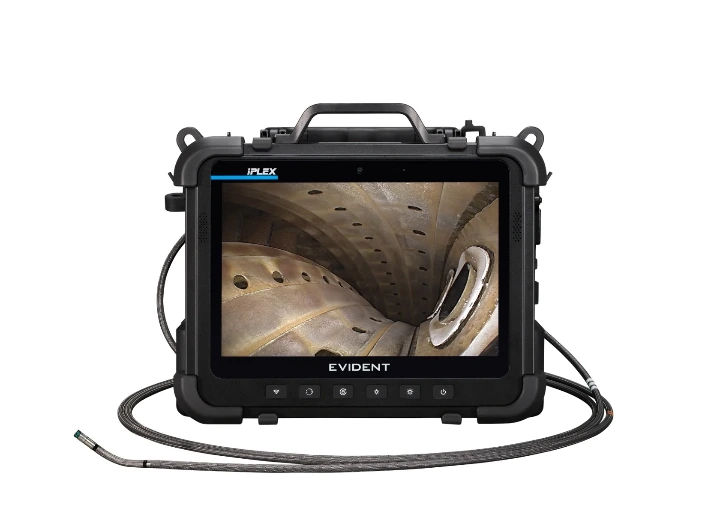
Comparative Analysis: Traditional Visual Inspection vs. IPLEX ONE Videoscopy
Next, we analyze the operational differences between a standard approach and advanced technology:
Feature / Method | Traditional Analog Boroscopes | Industrial Videoscope IPLEX NX |
Image Quality | Standard resolution, prone to blind reflections on metal surfaces. | Edge-to-Edge clarity in real-time on a 10.1-inch WUXGA touchscreen with anti-reflective coating and high contrast. |
Lighting | Basic halogen or LED lamps (limited range). | Swoptix™ Multiview Technology: Instant switching between close/far focus and direct/side view without needing to remove the probe from the engine. |
Defect Measurement | Cross visual estimation or basic stereo measurement (high risk of misalignment). | Swoptix™ 3D full-screen measurement and monocular modeling (3DAssist), completely eliminating the dependence on stereo tips. |
Navigability | Rigid mechanical articulation, slow and prone to wear from continuous stress. | True Feel electronic articulation combined with a modular, wireless design and wireless remote control unit for complex configurations. |
Long-Term Cost | Lower initial investment, but high accumulated costs due to prolonged downtimes and misdiagnoses. | Smart investment: Unified and scalable ecosystem through software licenses ("buy what you need"). Evolve the system without costly hardware replacements. |
Frequently Asked Questions (FAQs) about Aeronautical Inspection
1. What standards govern the visual inspection of aircraft engines?
The inspection is primarily governed by the manufacturer's maintenance manuals, airworthiness directives from aviation authorities such as theFAAand theAFAC, and NDT procedural regulations, in addition to the guidelines from the, además de las directrices de la ASNTfor personnel qualification.
2. What is the difference between a borescope and an industrial videoscope?
A traditional borescope typically uses optical fibers or rigid lens systems to transmit the analog image directly to the eye. An industrial videoscope integrates a digital sensor (such as a CCD or CMOS) at the tip of the probe to capture and send a high-resolution electronic image to a computer for analysis, recording, and dimensional measurement.
Monocular 3D modeling (like that used in theIPLEX™ One) creates a virtual and topographic replica from a single optical path, without requiring stereo tips. This allows the inspector to rotate the image to understand the actual morphology of the defect and position the cursors with absolute geometric certainty, reducing human error.
Absolutely. It is built for the flight line. It has an IP65 rating against dust and water, and is tested under military standards (MIL-STD) for drops and vibrations. Additionally, its all-weather design withstands extreme temperatures, and its anti-glare touchscreen allows for inspection in direct sunlight.
For inspecting commercial turbocharged engines, probes with diameters between 4.0 mm and 6.0 mm, and lengths ranging from 2.0 to 3.5 meters are recommended. The IPLEX™ One offers these precise configurations, incorporating a shorter distal end that facilitates smooth insertion into the more intricate channels of the compressor and turbine, reducing the risk of wear or blockages.
Be part of the future of aviation maintenance.
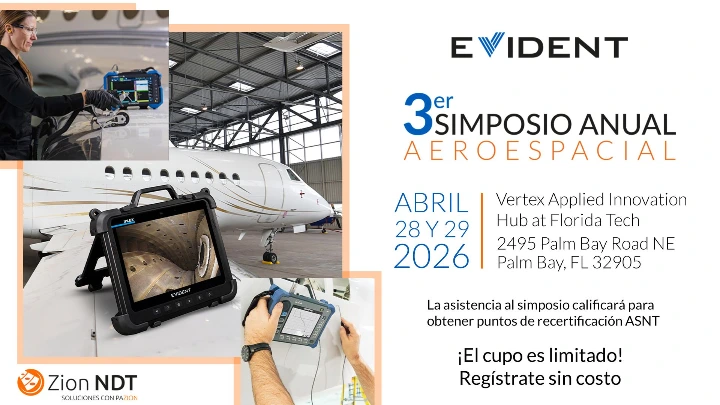
Join us at the3rd EVIDENT Aerospace Symposium, a technical experience designed to take your NDT processes to the next level. The event is on28and29ofAprilof2026at theVertex Applied Innovation Hub (Palm Bay, FL).
Related equipment
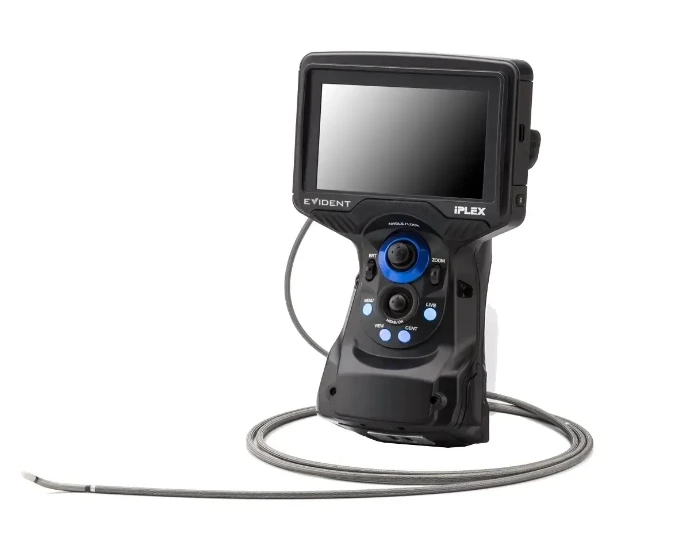
IPLEX G Lite /
G Lite-W
The videoscopeIPLEX GX/GTfeatures interchangeable light sources and insertion tubes, an 8-inch touchscreen, and advanced image processing capabilities. As a result, it provides an optimal balance of versatility, image processing capabilities, and ease of use.
IPLEX G Lite /
G Lite-W
The videoscopeIPLEX GX/GTfeatures interchangeable light sources and insertion tubes, an 8-inch touchscreen, and advanced image processing capabilities. As a result, it provides an optimal balance of versatility, image processing capabilities, and ease of use.
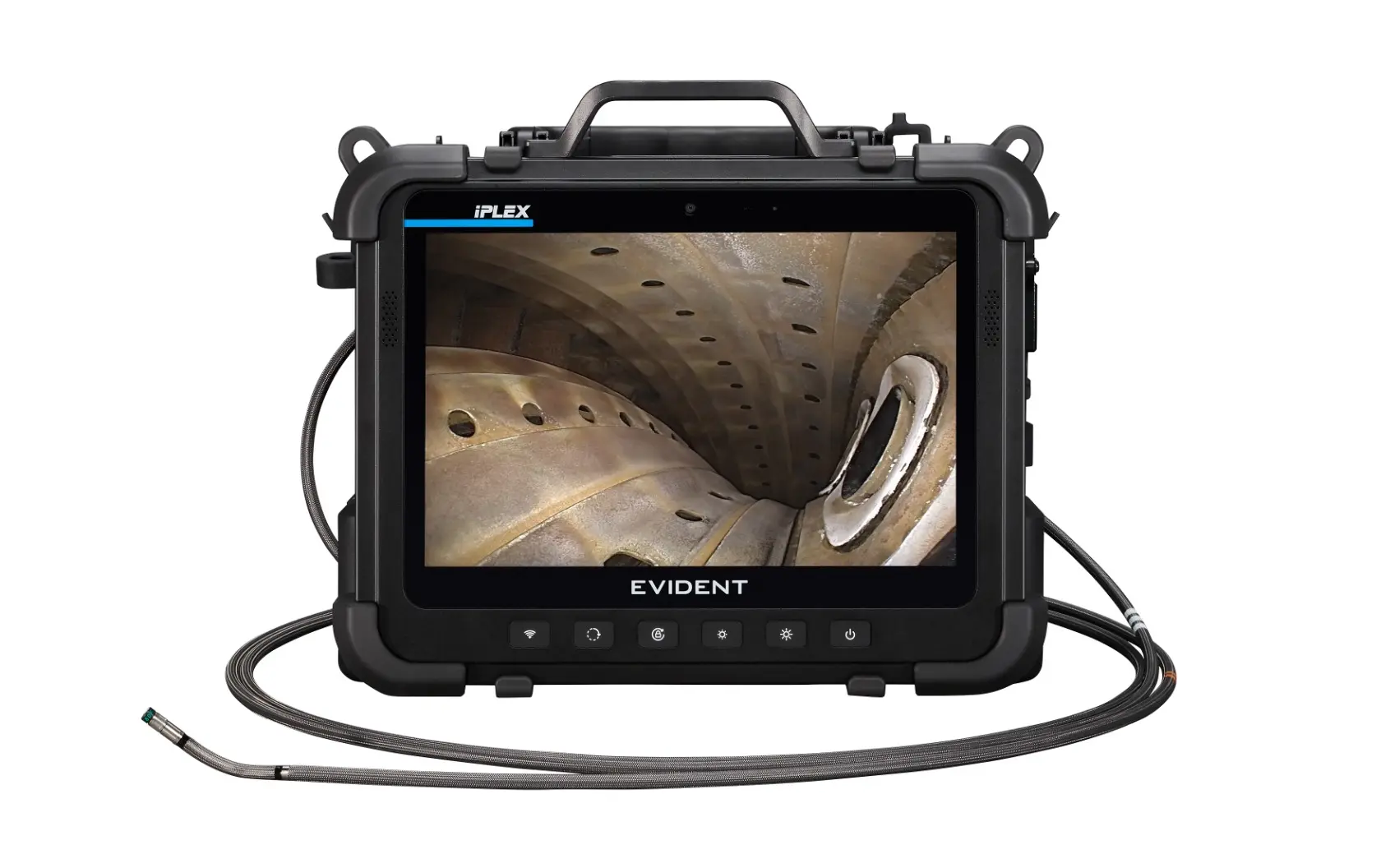
IPLEX ONE
IPLEX™ Oneis a unified software-based platform that allows you to work faster, see more, and stay ahead, regardless of the environment or application.