
In the industry ofaviationandspace exploration, overlooking a microcrack in a critical component is directly catastrophic. Whether we are talking about the maintenance of a commercial fleet in the hangars of central Mexico, the manufacturing of turbines in the aerospace cluster of Bajío, or the inspection of modules on the International Space Station, precision must be the hallmark of quality in your maintenance area.
When visual or superficial inspection methods are not sufficient, electromagnetic physics offers a compelling answer.
This is where Eddy Currents position themselves as the method of Non-Destructive Testing (NDT) by excellence to detect millimeter discontinuities before they compromise aerospace structural integrity.
Challenges of aerospace
structural integrity
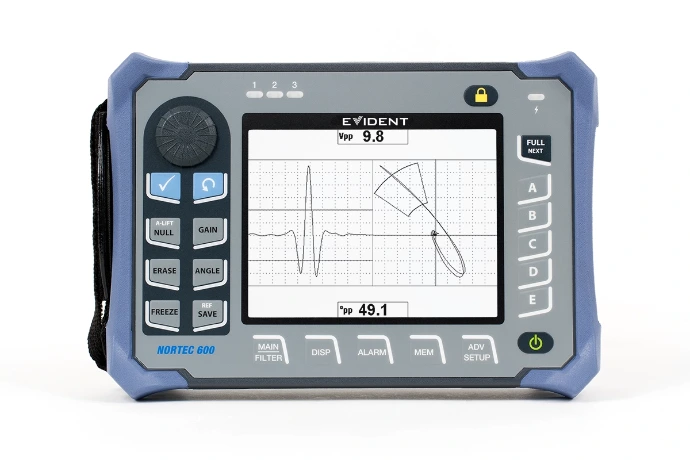
How does the Nortec 600 technology work?
Field Generation
A coil with alternating current creates a primary magnetic field that, when approaching a conductive metal, induces a flow of electrons on the surface of the part.
Induction of Currents
These Foucault currents generate a second magnetic field that acts as a mirror, allowing the equipment to constantly analyze the integrity of the material.
Anomaly Detection
Any crack or corrosion interrupts the electric flow, altering the secondary field and showing a variation in the impedance plane of the equipment in real time.
Critical Applications and Regulations
In the aerospace industry,Non-Destructive Testing (NDT)shines in scenarios where the margin of error is simply zero. It is not just about cutting-edge technology, but about a trust ecosystem where the physics of materials meets the rigor of the law.
Where is its application vital?
The most critical applications of this method ensure structural integrity at points where failure is not an option:
Inspection of holes and rivets:Identification of subsurface cracks invisible to the human eye in areas of high stress concentration, such as the fuselage and wings.
Evaluation of turbine blades:Early detection of thermal fatigue in components exposed to extreme temperatures and high revolutions.
Maintenance in extreme conditions:From commercial hangars to theInternational Space Station (ISS), where reliability must be absolute against vacuum and cosmic radiation.
The Regulatory Framework
For an inspection to be valid, legal, and safe, it must pass a triple regulatory filter that guarantees excellence in equipment, process, and inspector.
International Standards
The main technical support comes from the standardASTM E1004(specific for electromagnetic conductivity), operating under the global safety guidelines set by theFAA(U.S.) and theEASA(Europe). This robust framework is complemented by quality management certificationsAS9100andAS9110, pillars of the aerospace and maintenance (MRO) industry.
Mexican Legislation
In Mexico, these inspections are strictly regulated by theFederal Civil Aviation Agency (AFAC). Compliance is dictated through theOfficial Mexican Standards (NOM):
NOM-145/2-SCT3-2001:Regulates the operation of aeronautical workshops and their technical control methods.
NOM-006-SCT3-2012:Establishes the obligation of maintenance programs and the monitoring of structural integrity.
Personnel Certification
A diagnosis is only as reliable as the inspector who signs it. Within national territory, it is required that technicians have certifications under standardsISO 9712:2021or the recommended practiceSNT-TC-1A. To ensure this level of precision,Zion NDToffers training and certification programsthat empower personnel with the necessary technical competencies to operate under international standards. This is complemented by their que facultan al personal con las competencias técnicas necesarias para operar bajo estándares internacionales. Esto se complementa con su Service Center, which hascalibration laboratoriesaccredited by theMexican Accreditation Entity (EMA), ensuring that both the human and technological factors meet the demanding requirements.
How does the NORTEC 600 work?
For electromagnetic theory to be useful in the field, you need equipment that translates imperceptible impedance variations into clear data for the inspector. TheNORTEC 600is the bridge between complex physics and operational diagnostics.
Thisfault detectorstands out for its signal-to-noise ratio. In practice, this means that the equipment's digital filters eliminate interference caused by material roughness or variations in the distance between the probe and the part (lift-off effect).
The technology of theNORTEC 600integrates a high-resolution VGA screen that displays the impedance plane in real time. When the probe crosses a crack, the signal on the screen shifts, forming a specific phase angle. A trained inspector not only sees that there is a defect, but can also determine the depth and severity of the crack based on the amplitude and angle of that signal. Its robust design, intended for hostile industrial environments, ensures that external factors such as dust or moisture do not affect the accuracy of the reading.
Penetrant Liquids vs.Eddy CurrentsTo understand the technological leap, let's compare the most common surface method with induced current technology.
To understand the technological leap, let's compare the most common surface method with induced current technology.
Operational Characteristic | Penetrant Liquids | Eddy Currents |
Surface Preparation | Requires thorough cleaning, paint removal, and drying. | Minimal. Can inspect through paint and non-conductive coatings. |
Inspection speed | Slow. Requires penetration and developing times. | Immediate. Real-time results when passing the probe. |
Detection depth | Only defects open to the surface. | Detects surface and subsurface cracks. |
Environmental impact and cleaning | Use of chemicals, solvents, and need for waste management. | Completely clean and dry method. No chemical consumables. |
While penetrant liquids have a lower entry cost, the hidden expenses in consumables, downtime for cleaning, and the inability to see beneath the paint make them inefficient for continuous aerospace maintenance. TheNORTEC 600requires an initial investment in technology and training, but the return on investment (ROI) is substantial by reducing inspection times by 60% and avoiding unnecessary disassembly of critical components.
Frequently asked questions(FQs)
They are primarily designed to detect fatigue cracks, surface and subsurface corrosion, and variations in heat treatment or conductivity of metallic materials.
No. One of the greatest advantages of this technology is its ability to detect cracks through non-conductive coatings such as paint or anodizing, saving hours of preparation work.
It requires level II technical training in Eddy Currents. However, the equipment has an intuitive interface, preconfigured menus, and digital filters that greatly facilitate the interpretation of the signal in the impedance plane.
They are used to ensure the structural integrity of pressurized modules and components. The technology is vital because it is portable, generates no waste (crucial in microgravity), and provides immediate results on metal fatigue.
Aerospace structural integrity does not allow for assumptions. Implementing a robust Non-Destructive Testing (NDT) program with Eddy Current technology not only helps you comply with international regulations but also optimizes your maintenance times, reduces operational costs, and most importantly, ensures operational safety. Non-Destructive Testing (END/NDT) robust with Eddy Current technology not only helps you comply with international regulations but also optimizes your maintenance times, reduces operating costs, and most importantly, ensures operational safety.
At ZION NDT, we understand the challenges of the industrial and aerospace sector in Mexico. We not only provide world-class technology like the NORTEC 600, but we also offer technical support, training, and consulting to help your team maximize the use of these tools.ZION NDT, we understand the challenges of the industrial and aerospace sector in Mexico.We not only provide world-class technology like the NORTEC 600, but we also offer technical support, training, and consulting to help your team make the most of these tools.
Are you looking to optimize your inspection processes or solve chronic maintenance issues?Contact our specialists atZION NDTto request a live demonstration or a specialized quote. Let's talk engineer to engineer and find the exact solution your plant needs.
Do you want to see the future of aerospace maintenance in action?

Related equipment
Nortec® 600
TheNortec® 600is a compact and durable eddy current flaw detector. It stands out for its high visibility screen and high-quality digital circuits, allowing for precise inspections in any lighting environment.