
Weld inspection is the systematic technical evaluation aimed at verifying the mechanical integrity, metallurgical quality, and dimensional compliance of a welded joint, ensuring its conformity with international codes and regulations.In high-risk sectors such as petrochemicals, power generation, or civil infrastructure, early detection of discontinuities—whether surface cracks or internal volumetric defects—is the only effective barrier between safe operation and catastrophic failure.
However, there is no universal method. The choice between conventional ultrasound (UT), phased array, eddy currents, or remote visual inspection strictly depends on critical variables: the type of base material, the geometry of the joint, the available access, and the type of defect being characterized.
In today's industry, the cost of an unplanned failure far exceeds the investment in prevention. An undetected root defect today can mean a critical plant shutdown or an environmental leak tomorrow. Therefore, inspection technology should be seen as an asset for operational continuity.
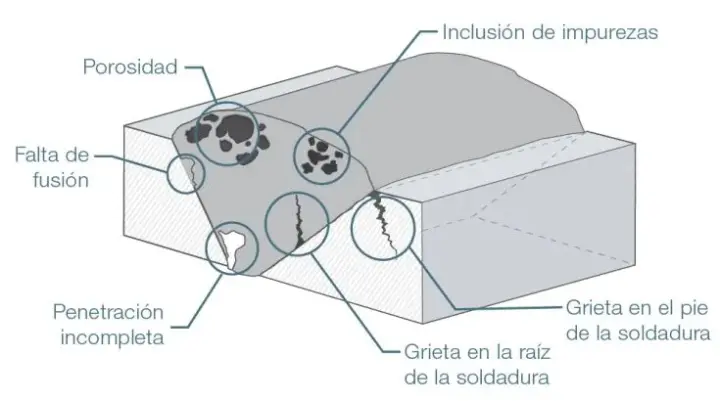
Welding inspection
by Eddy currents
The inspection by eddy currents (Eddy Current Testing or ECT) is an electromagnetic technique that we at Zion NDT recommend as a superior alternative to traditional liquid penetrant or magnetic particle testing, especially when speed and cleanliness are critical. This method induces electrical currents in the conductive material to detect changes in impedance caused by discontinuities.
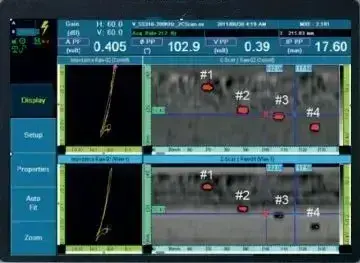
Eddy currents
Rapid and effective detection of surface and subsurface cracks
- High probability of detection without the need for stripping.
- Time savings due to wide coverage and fast scanning.
- Replacement of tests with penetrant liquids or magnetic particles.
More information
What defects does it detect?
This technique is highly sensitive for the detection and sizing of:
- Surface and subsurface cracks:Ideal for locating fatigue or stress corrosion cracks that are not visible to the naked eye.
- Porosity and lack of fusion:Detects discontinuities open to the surface or slightly below it.
- Coating thickness measurement:It allows for the verification of the paint thickness over the weld simultaneously with the inspection.
Materials and usage conditions
The physical principle requires that the inspected material be a conductor of electricity.
- Materials: It is effective in both ferromagnetic materials (such as carbon steels) and non-ferromagnetic materials (stainless steel, aluminum, titanium).
- Key operational advantage: Unlike penetrant liquids, eddy currents allow inspection through non-conductive coatings (paint, epoxy) typically in the range of 0.5 mm to 2.0 mm, without critical loss of sensitivity and maintaining an optimal signal-to-noise ratio.
Associated regulations
To ensure the reliability of the results, at Zion NDT we align our procedures with international standards such as:
- ISO 17643:Non-destructive testing of welds using complex plane analysis.
- ASTM E376:Standard practice for measuring coating thickness using magnetic field or eddy current methods.
Instrumentation for electromagnetic inspection
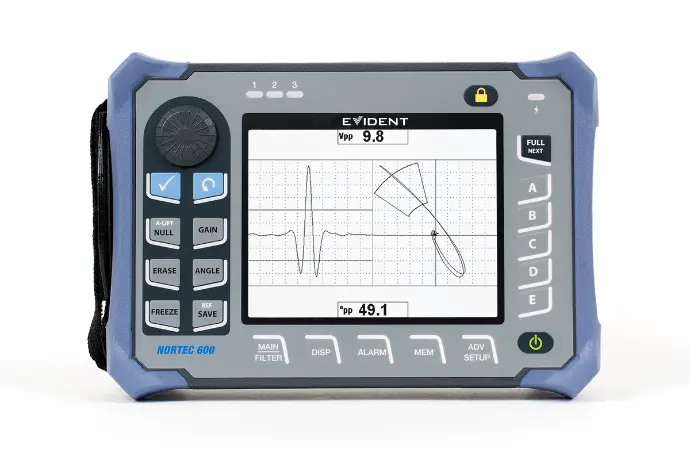
We use equipment such as theNORTEC® 600, a portable unit that combines high-fidelity digital circuits with a high-contrast display. This allows us to interpret clear signals and distinguish real defects from geometric noise, even in direct sunlight or adverse industrial environments.
Conventional ultrasound
for weld inspection
Conventionalultrasound (UT)is the backbone of modern volumetric inspection. At Zion NDT, we provide specialized equipment for this technique, based on the propagation of high-frequency sound waves to detect internal discontinuities that are invisible from the surface.The principle is simple, yet powerful: sound travels through the material and reflects when it encounters a discontinuity, allowing us not only to detect the defect but also to locate its exact depth.
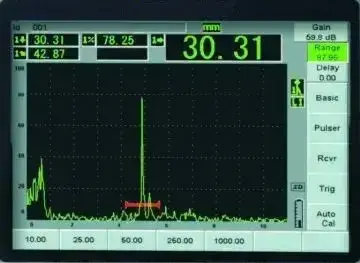
Conventional ultrasound
High-quality defect detection for excellent ease of use
- Robust and ergonomic setup to face the most demanding environments.
- Intuitive and practical interface for experienced inspectors and novices.
- Wide range of UT probes for detecting and sizing weld defects.
More information
Volumetric defects and sensitivity
Unlike surface techniques, ultrasound is exceptional for assessing the total volume of the weld. It is capable of detecting:
- Internal cracks and lack of fusion:Identifies critical separations within the weld bead or in the heat-affected zone.
- Slag inclusions and porosity:Locates trapped contaminants or gas bubbles that weaken the structure.
- Delaminations:Detects layer separations in the base material, crucial before starting to weld.
Advantages over industrial radiography
Although radiography has been a historical standard, conventional ultrasound offers superior operational and safety advantages that we prioritize at Zion NDT:
- Total Safety:It does not emit ionizing radiation, eliminating the need to evacuate the plant or stop nearby operations.
- Detection of Planar Defects:UT is much more sensitive than radiography for detecting cracks oriented perpendicular to the beam (such as lack of side fusion), which are often "invisible" on a radiographic plate.
- Immediate Results:Provides real-time information without chemical developing times or digital processing, allowing for instant field decisions.
Frequent Use Cases
This technique is the gold standard for applications where structural integrity is non-negotiable:
- Welds in process piping and pipelines.
- Pressure vessels and storage tanks.
- Steel structures in bridges and industrial buildings.
- Maintenance inspection to measure thickness and remaining corrosion.
Failure detectors for harsh environments
To face the harshest environments, we rely on equipment such as the detectorsEPOCH® (series 650/6LT). These instruments combine a robust and ergonomic setup with high-quality detection capability. Their intuitive interface allows our inspectors—from novices to experts—to perform accurate measurements using a wide range of UT probes, ensuring reliability in every measurement.
Regulatory Compliance
Our UT procedures are governed by strict acceptance criteria such as ASME Section V (Boilers and Pressure Vessels) and AWS D1.1 (Steel Structures), ensuring that each evaluation has legal and technical backing.
Remote visual inspection
in hard-to-reach welds
TheRemote Visual Inspection (RVI or Videoscopy)is often the first line of defense in industrial diagnosis. At Zion NDT, we understand that many of the most critical welds are not visible to the inspector, but hidden within complex geometries.
This technique uses articulated probes with high-resolution cameras to "transport the expert's eyes" inside the part, allowing for the evaluation of the weld root and internal surface without destructive interventions.
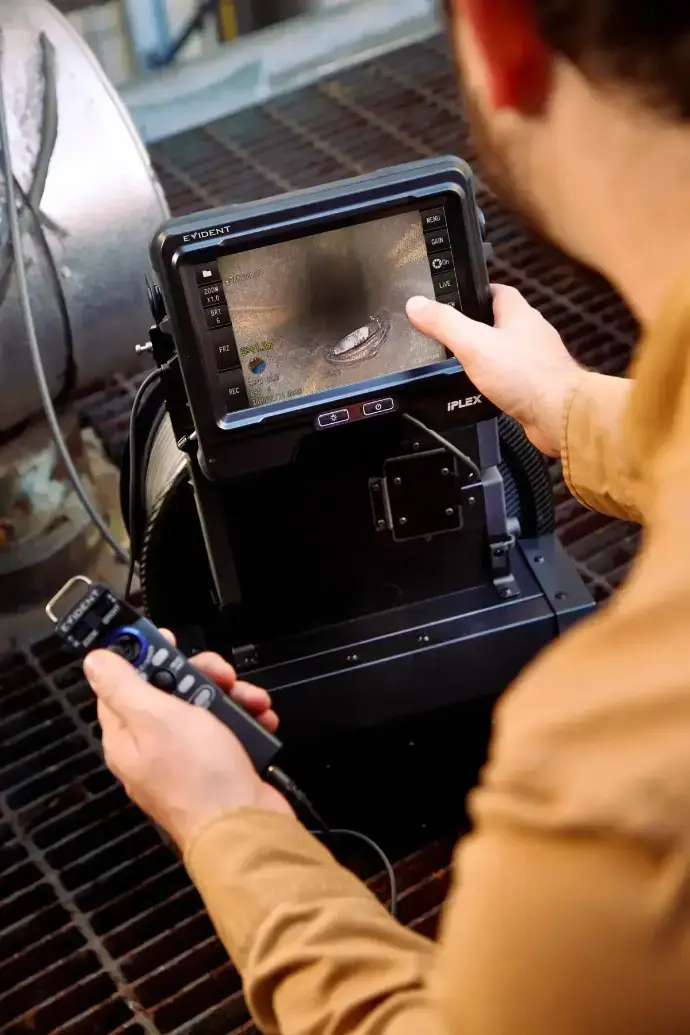
Remote visual inspection
Inspection in hard-to-reach areas
- The best image quality for clear visualization.
- Increased detection probability thanks to vivid colors and sharp images.
- Effective assessment of damage present in the weld.
More information
When is Remote Visual Inspection indispensable?
Remote Visual Inspection?
This methodology is applied where the human eye cannot reach directly. It is the standard for inspecting:
- Interiors of process pipes (even accessing small diameters from 4 mm or 6 mm):Especially to verify penetration in the weld root (root pass) and detect obstructions.
- Turbine and generator components:Where disassembly for direct visual inspection would be economically unfeasible.
- Heat exchangers and boilers:To locate localized corrosion or cracks in tube-plate joints.
Technical and operational benefits
The evolution of digital optics has transformed this technique into a precision tool. By implementing advanced RVI solutions, we at Zion NDT guarantee:RVIincreased Probability of Detection (POD):
- Probability of Detection (POD) Increase:Thanks to modern sensors that capture vibrant colors and sharp images, we can distinguish subtle shades of oxidation or thermal discoloration (heat tint) that indicate welding issues, clearly differentiating them from shadows or dirt.
- Effective damage assessment:It's not just about "seeing," but about measuring. Advanced optics allow us to quantify the size of a crack or the depth of a pit on screen.
- Operational efficiency:It allows for a thorough inspection without the need to disassemble complex machinery, drastically reducing downtime.
High-resolution industrial videoscopes
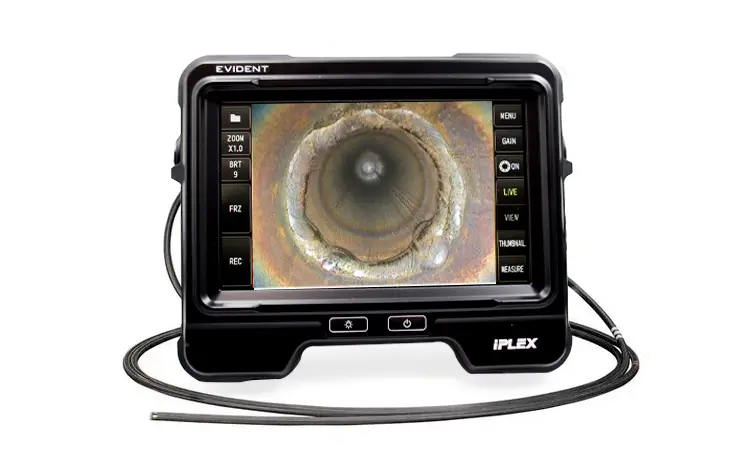
For these critical tasks, we use industrial videoscopes from the IPLEX series (such as the GX/GT).IPLEX (como el GX/GT). These devices provide us with the best image quality for clear viewing and feature interchangeable light sources(UV and IR), allowing us to adapt to any dark or reflective environment to deliver accurate diagnostics.
Phased Array Ultrasound for critical welds
ThePhased Array Ultrasound (PAUT)It is an advanced technique that uses probes with multiple independent elements to direct and focus sound beams through electronic control. Unlike conventional methods, this technology allows us at Zion NDT to perform sector scans on complex geometry welds or thick materials, ensuring total coverage where the margin of error must be zero.
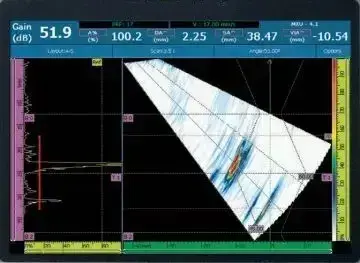
Ultrasonido multielemento (P hased Array)
Streamlined inspection process
- High-speed detection capabilities that facilitate data interpretation.
- Reduced inspection time compared to radiography.
- Immediate results that allow for instant problem detection and resolution during the inspection process.
More information
Key differences compared to Conventional UT
While conventional ultrasound uses a single crystal with a fixed angle (which forces the inspector to manually move the probe in complex patterns to cover the volume), Phased Array uses probes with multiple elements (16, 32, 64, or more).
- Electronic beam control:This allows us to direct and focus the sound beam electronically without moving the probe. We can scan the weld with multiple angles simultaneously, ensuring that even misoriented defects (such as a vertical lack of fusion) are detected.
Inspection speed and efficiency
PAUT transforms the workflow into a streamlined inspection process.
- Coverage in a single pass:By covering multiple angles at once, we drastically reduce scanning time.
- Superiority over radiography:We offer a reduced inspection time compared to radiography, as we eliminate the need to cordon off areas for radiological safety and the waiting times for film development. Plant activity can continue while we inspect.
- Direct Economic Advantage:By eliminating radiation, there is no need to evacuate personnel or stop adjacent work (welding, painting, assembly). This translates into a direct saving of man-hours and avoids bottlenecks in the project schedule.
Data interpretation and immediate results
The greatest advantage of PAUT is visualization. Unlike the abstract waves of conventional UT, Phased Array generates sector images (S-Scan) that resemble a cross-section of the weld.
- Intuitive visual analysis:These high-speed detection capabilities facilitate data interpretation, allowing the inspector to "see" the location and shape of the defect within the material with great clarity.
- Real-time decision making:We obtain immediate results that allow for instant problem detection and resolution. If there is a defect, the welder can receive feedback on the spot, preventing the error from being repeated in the next joint.
Cutting-edge technology
for defect characterization
To lead these inspections, at Zion NDT we operate with cutting-edge equipment such as theOmniScan™ X4. This multi-technology detector allows us to execute advanced techniques (such as TFM and PCI) to characterize complex defects with millimeter precision.
Comparison of methods
for weld inspection
Choosing the right technique is essential to balancecosts, time, and above all, the safety of the operation.At Zion NDT, we help our clients select the ideal methodology based on the critical variables of the project. Below, we present a technical comparison of the analyzed solutions:
Method | Type of Defect | Advantages | Limitations |
Surface and subsurface cracks; fine porosity. | Quick inspection without the need to remove paint or coatings. | Only applicable to conductive materials; limited penetration. | |
Conventional Ultrasound (CU) | Internal volumetric defects (inclusions, lack of fusion). | High penetration in thick materials; safe (no radiation). | Scanning is manual and slower; interpretation depends entirely on the operator. |
Phased Array (PAUT) | Complex defects, misoriented cracks, and vertical lack of fusion. | Very high inspection speed; easy-to-interpret images and data recording. | More expensive equipment and requires more technical training. |
Remote Visual Inspection (RVI) | Visible damage on root or internal surface (corrosion, cracks). | Access to unreachable areas (pipes, turbines) without disassembling machinery. | Only detects what is visible on the surface; does not measure internal depth of the material. |
Frequently Asked Questions
1. What is weld inspection to us?For Zion NDT, it is the set of rigorous techniques applied to assess the quality and integrity of a joint, detecting defects without compromising the piece. We guarantee operational safety and regulatory compliance.
2. What are non-destructive tests (NDT) in welding?They are methods that allow for the identification of surface or internal defects without damaging the component. We specialize in effective technologies such as ultrasound, eddy currents, remote visual inspection, and Phased Array.
3. What defects can we detect?We can identify a wide range of discontinuities, including cracks, porosity, lack of fusion, inclusions, and volumetric defects, with millimeter precision depending on the selected technique.
4. When is eddy current inspection recommended?It is the ideal option for detecting surface defects in conductive materials when speed and cleanliness are required, as it allows work to be done without the need to remove paint or coatings (up to a certain thickness).
5. In what cases do we apply conventional ultrasound?It is the standard for detecting deep internal or volumetric defects. We consider it a superior alternative to radiography due to its immediacy and safety, as it does not emit ionizing radiation.
6. What is the difference between conventional ultrasound and Phased Array?The key lies in beam control: Phased Array allows for electronic direction and focusing of the ultrasonic beam. This achieves greater coverage, higher speed, and a graphical visualization (S-Scan) that is far superior to conventional ultrasound.
7. What advantages does Phased Array offer in critical welds?It offers a higher probability of detection (POD) and drastically reduces inspection times. The results are immediate, which is vital for decision-making during plant shutdowns or critical projects.
8. What is remote visual inspection (RVI) used for?Designed to assess hard-to-reach areas (such as the interiors of pipes or turbines). We use videoscopes that provide a clear view of the welding condition without the need for costly disassemblies.
Related equipment
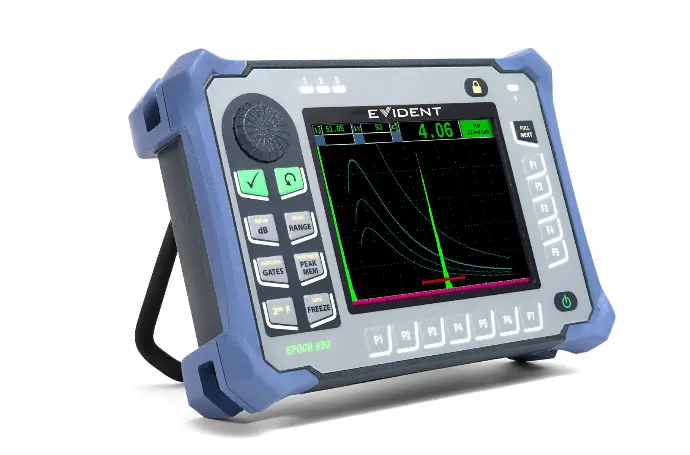
EPOCH 650
TheEpoch 650is a conventional ultrasonic flaw detector with excellent inspection capability and utility for a wide variety of applications.
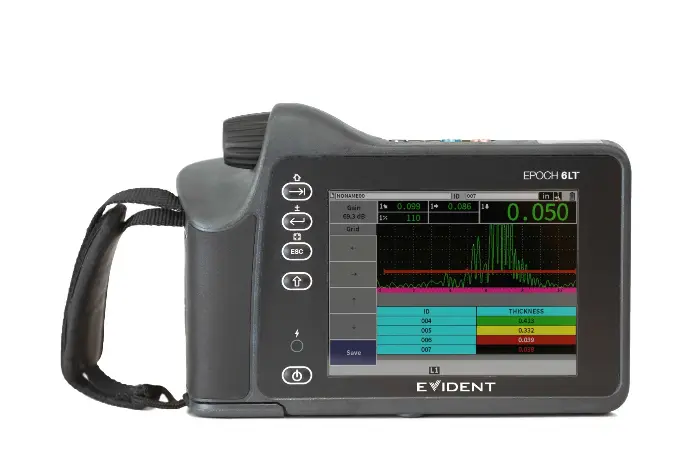
EPOCH 6 LT
The Epoch 6LT defect detector combines the functionality of a powerful ultrasonic defect detection device with an ideal form factor for applications that require vertical rope work or maximum portability.
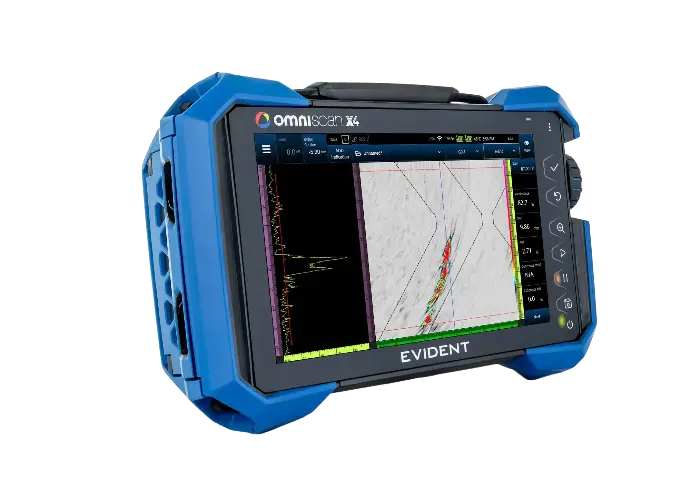
OMNISCAN X4
Formando una solución portátil, y sobre todo poderosa, la velocidad y la versatilidad de la serie multitecnológica OmniScan™ X4 aumentan simultáneamente su productividad y la confianza en sus análisis.
NORTEC 600
It is capable of generating highly visible and contrasting eddy current signals under any lighting conditions.
IPLEX GX/GT
The videoscopeIPLEX GX/GTfeatures interchangeable light sources and insertion tubes, an 8-inch touchscreen, and advanced image processing functions. As a result, it provides an optimal balance of versatility, image processing capabilities, and ease of use.
IPLEX GX/GT
The videoscopeIPLEX GX/GTfeatures interchangeable light sources and insertion tubes, an 8-inch touchscreen, and advanced image processing functions. As a result, it provides an optimal balance of versatility, image processing capabilities, and ease of use.