
Master scanning in pipe welds thanks to this versatile tool
When the AxSEAM™ scanner, the strategy of putting oneself in the shoes of a field inspector was applied. The goal was to make pipe scanning as easy as possible by addressing typical problems that slow down and complicate inspectors' work.
The request from pipe inspectors addressed with the AxSEAM scanner
After consultations with pipe inspectors, a list of common complaints associated with scanning circumferential and longitudinal weld seams when using multi-element ultrasonic techniques was compiled.(Phased Array)and time-of-flight diffraction(TOFD).And, to provide a direct solution to these problems, the features of the AxSEAM scanner were composed.
1. Strength and tool-free probe supports to prevent lifting or deviation.
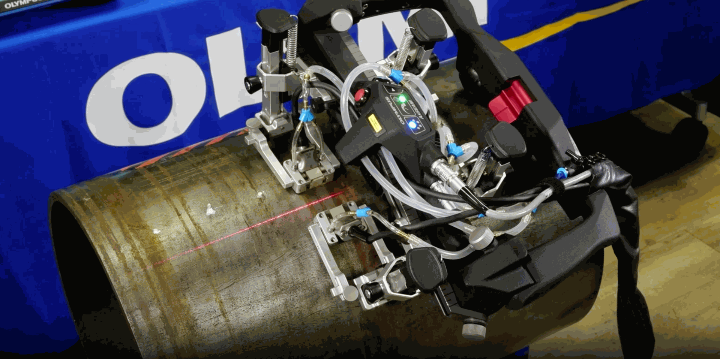
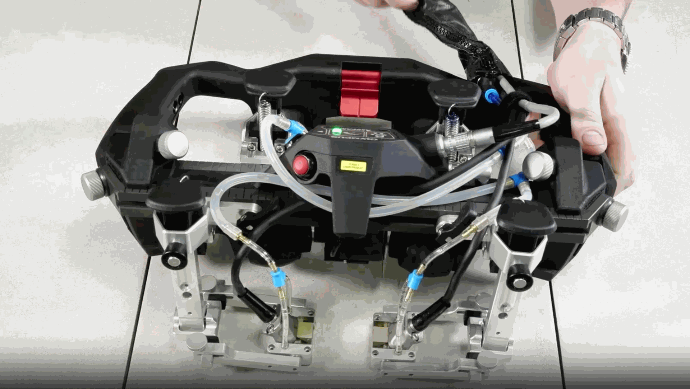
First, the design team addressed and solved the problem of complicated and unreliable probe supports. The probe supports of the AxSEAM scanner have been fully developed to facilitate probe installation, adjust index compensation, and acquire reliable ultrasonic data.
Key optimizations:
- A hook keeps the supports elevated during probe and shoe handling.
- These supports feature a retractable and pivoting mechanism to prevent the probe from lifting and deviating during scanning, which helps ensure consistent coupling.
While the probe supports are flexible, they are also stable and durable. Ultrasonic testing inspectorsPhased Array(PA),who have used the scanner in the field, have noticed its robustness. The design of this scanner is intended to withstand the demanding requirements of pipe inspection work.
2. Improved scanning efficiency to prevent new scans
Another of the exclusive innovations of the scannerAxSEAMis its ScanDeck™ module. With a central and direct position, similar to that of a dashboard, the module provides dedicated warning lights for excessive scanning speed or lack of couplant; this is to ensure that the acquired data is reliable and none is lost. Since inspectors can focus on the scanner and do not have to look at the acquisition instrument for validation, the scanning work is much simpler.
In terms of smoothness, the rubber-molded magnetic wheels also favor both the coupling of the scanner over the pipe and smooth movement, reducing any effort on the part of the operator.
3. Easy transition between longitudinal seams, circumferential seams, and various pipe diameters
With the AxSEAM scanner in the field, the inspector may not require another scanner.
Its tool-free adjustment means quick adaptation to...
- different pipe diameters, and
- the alternation between scans for longitudinal and circumferential weld seams.
Inspectors can use the AxSEAM scanner to inspect a wide range of pipe diameters:
- Longitudinal welding: In pipes with an outer diameter ranging from 152.4 mm (6 in.) to flat metal plates.
- Circumferential welding: In pipes with an outer diameter as small as 114 mm (4.5 in.) with two probes or 254 mm (10 in.) with four probes.
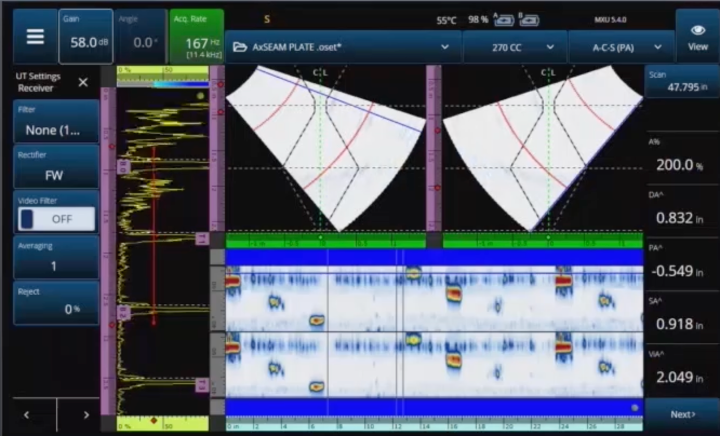
The four probe supports allow for quick detection using multi-element ultrasonic (Phased Array, PA) or conventional ultrasonic (UT), as well as examination of regions of interest (ROI) using the total focusing method (TFM), without the need to change probes.
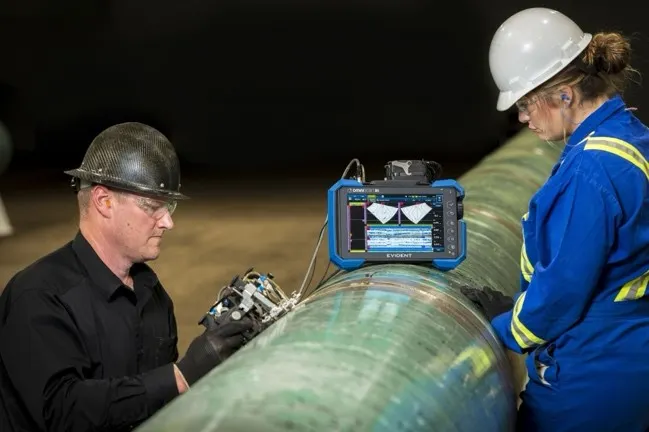
When using the multi-element ultrasonic flaw detector (Phased Array) OmniScan X4, the AxSEAM scanner can perform inspections using PA, TOFD, and TFM techniques with the same probes.
4.Get rid of cumbersome and overly complex equipment
As Brandon Reitz mentions in his video «Efficient Inspection of Longitudinal Weld Beads», the AxSEAM scanner is equipped with a «robust and ergonomic design that is lightweight and easy to handle».
The AxSEAM scanner and its accessories are housed in a compact structure. This means that the NDT inspector has everything needed to carry out multi-element ultrasonic pipe scans (Phased Array, PA) without being overwhelmed by bulky equipment, whether in the field or during transport.
To fully grasp the concept of optimal portability, versatility, and simplicity of this scanner, experiencing it practically is the best way. If you are interested in a demonstration, please contact your local Olympus representative today.
Product Manager, Scanners and Inspection Solutions