
In the maritime industry,ultrasonic testing (UT)facilitates the non-destructive detection of defects in boats, yachts, and other maritime vessels. Routine UT inspection helps ensure that marine vessels comply with regulatory requirements and laws to keep crews, passengers, and cargo safe.
A company that prioritizes ultrasonic inspections ismarineSOLUTIONS: an international inspection company for yachts.
Yacht Inspection: New and used maritime vessels
Vessel inspections include ultrasonic testing with the EPOCH™ 650 flaw detector. UT inspections on vessel materials cover:
- Ultrasonic testing of vessels and masts made of composite materials
- Ultrasonic testing of hull plates and other components of vessels
- Ultrasonic testing of welds
Cem Baykent, a materials science engineer and inspector at marineSOLUTIONS, was interviewed for more information on ultrasonic testing in the maritime industry.
Challenges posed by the inspection and maintenance of vessels
TheInternational Association of Classification Societies (IACS)provides a system to promote safety, regulation, compliance, and maintenance of ships and marine units. Each society establishes rules with technical standards.
Despite the existence of these standards,non-destructive testing (NDT) is not mandatory in the maritime industry as it is in the aerospace industry. Additionally, inspection documentation is not included in the case of a yacht or recreational vessel unless it is classified by a member of IACS. This is due to the craftsmanship experience of most yacht manufacturers whose construction skills are not yet standardized.
Most yachts are also not built with inspection in mind. Interiors are often filled with coverings, equipment, tanks, rigging, and machinery. This design prevents access to the hull shell and its reinforcement from the inside. As a result, dismantling is often only justified after strongly suspecting the existence of a defect or damage.
The materials of the boat can also be difficult to inspect. To minimize weight, many modern boats are built with composite materials that combine fibers and resin matrices. The fibers can be arranged randomly, to follow with sheet flattening (known as chopped strand mat) or woven into fabric. The fiber material is often glass, aramid, or carbon; the matrix is often based on polymers such as polyester resins, vinyl ester, or epoxy.
Due to the common use of fiber-reinforced composites for boats and the safety margins that decrease both in designs and in boat materials (e.g., thinner hulls in modern yachts), the need to characterize and find defects in the materials increases.
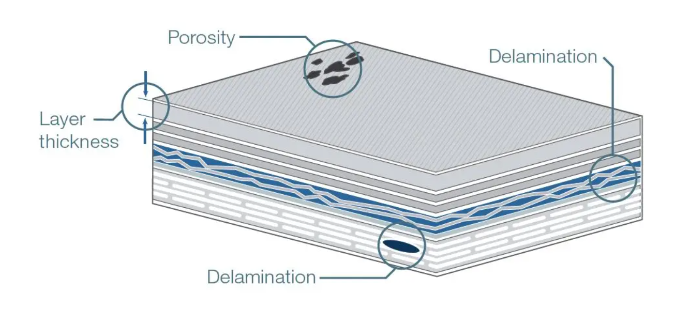
Delaminations, failures, and defects in composite fiber layers
Failures or hidden defects in the internal part of a composite structure can arise from many sources: manufacturing anomalies, applied stresses or weaknesses, accidents, or inadequate repairs. These can significantly affect the structural integrity of a vessel.
Inspection companies, such as MarineSOLUTIONS, useultrasonic testingnon-destructive testing to accurately locate and size failures, cracks, voids, delaminations, and other defects in boats, yachts, and other marine vessels.
Understanding ultrasonic testing in the maritime industry
In summary, ultrasonic testing uses high-frequency acoustic energy for examinations and measurements. Ultrasonic testing can be used to detect and assess defects/failures, take dimensional measurements, carry out material characterization, and more.
An ultrasonic defect detector uses a probe to generate acoustic waves and measures the time it takes for that sound to leave the probe, travel through a material, bounce off a reflector, and return to the probe.
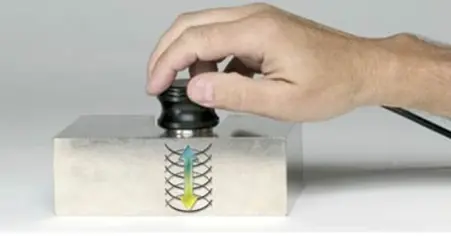
Acoustic impulse, generated by a transducer (probe), propagating (traveling) through a test piece and reflecting off the internal or back surface.
An ultrasonic flaw detector is used to locate and size discontinuities such as cracks, voids, porosity, and delaminations (loss of adhesion) in various materials and welds. Flaw/failure detection can be applied to almost any engineering material. Most inspections focus on steel and other structural metals; however, flaw detectors can also be successfully used to examine plastics, composites, fiberglass, and ceramics.
A flaw detector can also reasonably measure the thickness of the material, but it is not designed forprecision measurement. To learn more about these instruments, please refer to ourUltrasonic Flaw Detection Manual.
NDT technologies, such as ultrasonic flaw detection, are a powerful way to determine the integrity of a vessel's components or structure and to discover defects without causing any damage. Since NDT does not damage, stress, or destroy materials, inspecting the structures and components of a vessel saves time and costs [Eng. costs].
NDT inspections can be carried out on a vessel during the construction process, before delivery, purchase, during routine maintenance, damage inspection, or as part of post-repair inspections.In the commercial maritime vessel industry, ultrasonic non-destructive testing is generally applied to steel and aluminum vessels to detect and quantify corrosion.. Similarly, non-destructive ultrasonic testing can be used to measure the thickness and integrity of composite structures.
The inspection of structural welds in metals is a common application of NDT by ultrasound in the maritime industry. Among the types of weld defects are cracking, lack of fusion, incomplete penetration, porosity, and slag inclusions. All of these defects are potentially detectable through ultrasonic testing.
Combination of UT testing with NDT expertise for vessel inspections
When a NDT inspection program is not establishedfor the manufacturing stage,there often will not be reference standards for the manufacturing of non-commercial and recreational vessels. This makes ultrasonic testing work more challenging.
Inspection companies, such as marineSOLUTIONS, must leverage their knowledge and experience. With this in mind, marineSOLUTIONS has set up a small laboratory to examine different vessel materials, from multiple types of composite materials to various metals.
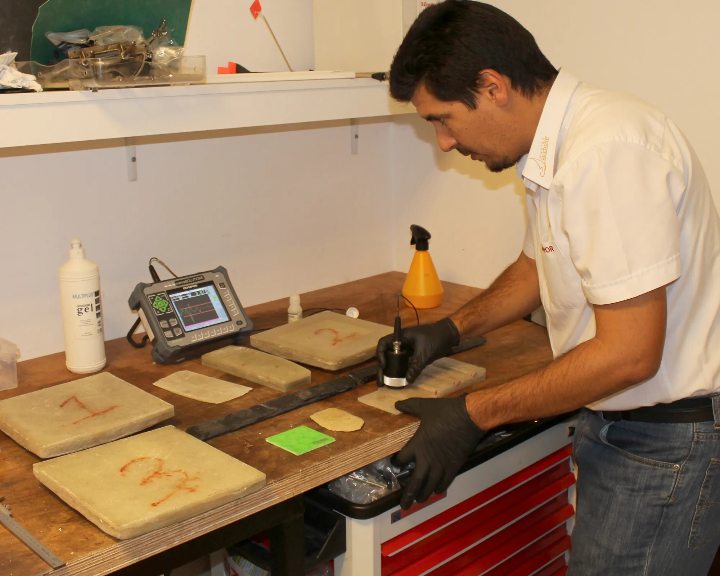
Cem Baykent uses the EPOCH 650 flaw detector with the M2008 probe to examine composite materials of maritime vessels.
"Ultrasonic testing in composites is still a niche: an undiscovered and untapped area in the world of NDT; as there is no regulation or standard guidance on what to do and when. Therefore, marineSOLUTIONS is largely building its own procedure and bringing specialized NDT knowledge through engineering staff,", said Cem.
Aside from composite materials, marine vessels are often constructed from aluminum or steel. Almost anything made of metals is subject to corrosion, particularly in the marine environment.
Cem pointed out that overlooking inspections of metal hulls is surprisingly common even when the compromised integrity of a hull poses a significant safety risk. In simple terms, the hull is the outer shell of a vessel's structure that is partially submerged in the sea. It protects the cargo areas, machinery, and accommodation of a vessel from weather conditions, flooding, and structural damage.
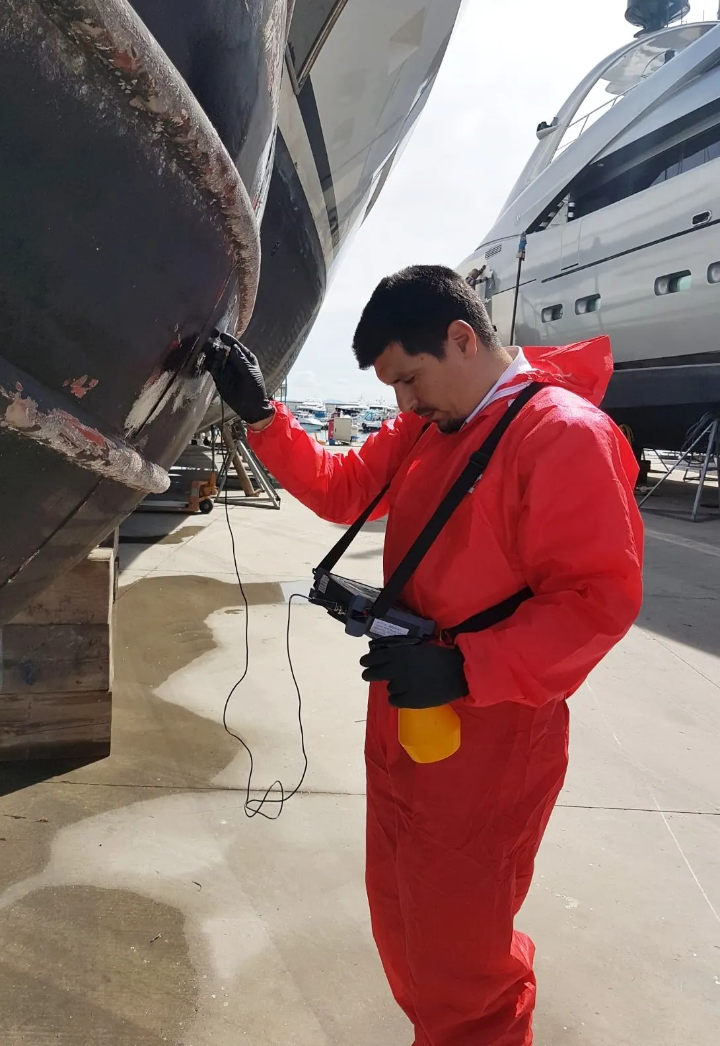
Cem Baykent inspects the hull of a marine vessel with an ultrasonic flaw detector.EPOCH 650
Regularly, boats are brought ashore to inspect the hull plates from the outside, even if it is just for a visual and tap inspection. However, the presence of fillers, coatings, and layers of paint on the exterior of the yacht's hull can make visual inspections difficult.
Above all, visual inspection only provides a limited view. Corrosion often develops from the inside. Only after most of the material is wasted due to corrosion can internal damage be detected from the outside using conventional methods.
Internal corrosion primarily progresses in areas that are almost impossible to see during bilge inspections. Access to the bilges for visual inspection is often limited due to tanks, machinery, and other components and structures that get in the way. However, if corrosion is not detected or treated, it can weaken the hull plates and lead to dangerous leaks, potentially resulting in structural failures. Therefore, it is important to regularly inspect the hull plates to enhance safety and minimize costs.Costs.
Reliable ultrasonic flaw detector for inspecting yachts
Formed by a team of experts, marineSOLUTIONS has a variety of instruments and standard samples to meet many requirements. At the core of the equipment, the company relies on the flaw detectorEPOCH 650thanks to its combination of performance and ease of use.
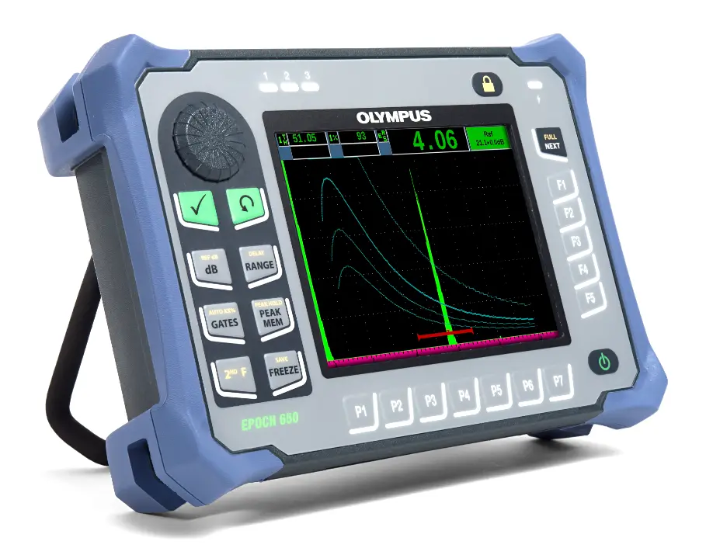
Ultrasonic flaw detectorEPOCH 650 from Evident
Below are three ways marineSOLUTIONS uses the flaw detector:
1. Ultrasonic testing on vessels and composite masts
To inspect the structures and composite materials of the vessels, marineSOLUTIONS combines the EPOCH 650 flaw detector with an M2008 probe equipped with a delay line (0.5 MHz; 1 inch in diameter). This probe is ideal for highly attenuating composite structures.
"Composite materials for yachts are anisotropic, which makes them even more complex. [Therefore], it is possible to obtain more information about anisotropic materials with the M2008 probe. The M2008 probe is powerful enough to penetrate thick fiber-reinforced polymer (FRP) composite materials. Its operation is remarkable and provides straightforward results. Probes from other renowned companies, designed for the same purpose, have been tested, and we have not achieved even approximate results," Cem stated.
In the case of composites, ultrasonic probes can be used to detect:
- Uniformity in laminate thickness
- Presence and type of delaminations
- Presence of voids or porosity
- Quality and adhesion of the laminate and integrity of repairs
- Inclusions and presence of foreign materials in the laminate
Ultrasonic testing on composite vessels and masts has many advantages:
- Only unilateral access is needed
- Portable equipment is used for inspections in remote locations or vertical work
- Minimal or no surface preparation is required
- High precision to determine the exact point of a hidden anomaly and its main characteristics, such as depth, size, and shape.
- Instant results and data are obtained

2. Measurement of corrosion in hull plates through ultrasonic testing
Another way marineSOLUTIONS uses the defect detectorEPOCH 650is to measure corrosion in hull plates.
Cem mentioned that "damage to the hull and mast is extremely common, and ultrasonic testing provides us with the means to establish the spatial extent of such damage. This knowledge leads to peace of mind for all involved and provides valuable information for estimating repair costs. Both are invaluable advantages."
The thickness of the metal plate can be evaluated non-destructively with ultrasonic thickness gauges without removing putty, paint layers, or other coatings. It is important to note that when assessing pitted plates, these devices deduce the minimum thicknesses of the plates using pre-established algorithms and can sometimes be incorrect.
Therefore, the company marineSOLUTIONS resorts to the defect detectorEPOCH 650with a dual element probe DL4R-6X20 (4 MHz) to inspect metal corrosion. In this way, it is possible to see the ultrasonic echo spectrum. [And] through the waveform, attenuation, and phase changes, an experienced NDT inspector can infer various information from a plate or structure. The inspector must also identify true echoes from reflections and false diffractions, among other information.
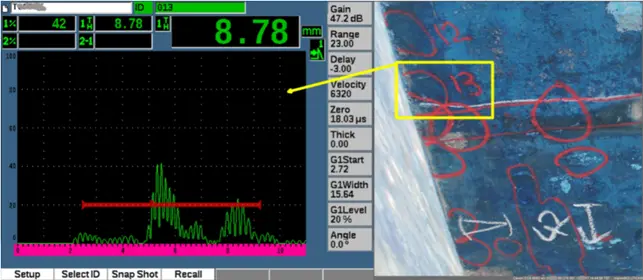
The ultrasonic defect detector EPOCH 650 shows a spectrum from an aluminum hull plate with a progressive development of pitting. The double peak, opposite the high peak on the left, indicates severe pitting corrosion. On the right, the visual inspection of the section associated with the hull plate reveals no signs of pitting corrosion. The damage is hidden by the external puttied and coated surface, as well as by tanks and other internal structures that block the interior.
3. Ultrasonic testing of welds
The company marineSOLUTIONS also uses the defect detectorEPOCH 650with an AM4R-8X9-70 angled beam probe to inspect welds.
While straight beam techniques can be very effective at detecting laminar defects, they are not effective when inspecting common welds, where discontinuities are not found parallel to the surface. The combination of the geometry of the weld, the orientation of the defects, and the presence of the weld crown or bead requires inspection from the side of the weld with the beam generated at an angle.
Transverse wave testing, also known as angled beam inspection, is aUT techniquethat is primarily used for weld inspections. The inspection of the weld is performed by emitting transverse waves in a plate at a selected angle manipulated from the probe to scan the entire weld.
In typical inspections, sound propagates (travels) through the piece to the generated angle and is then reflected at the same angle. Moving the probe back and forth allows the acoustic beam to cover the entire height of the weld. This scanning movement allows monitoring of the volume of the entire piece and detecting discontinuities in the fusion lines and in the weld structure.
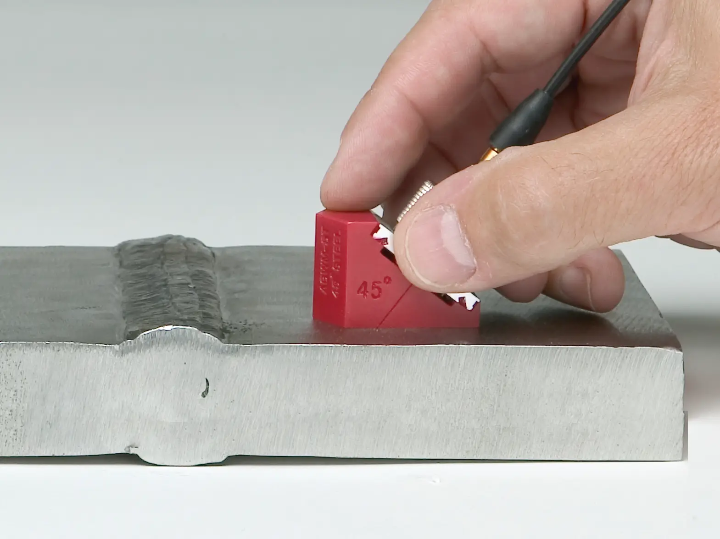
Angled beam probes are single-element probes used with a shoe to introduce a refracted transverse wave or longitudinal wave into the test piece. Here, a 45° shoe is shown.
UT inspection allows for the detection of the following defects in welds:
- Cracks in the weld area
- Discontinuities and incomplete penetration in welded joints
- Lack of fusion in welded joints
- Porosity in welded joints
- Slag inclusions in welded joints
- Areas with distortion
- Stratification of the metal in the weld
Evident as a supplier of NDT instruments
When the company marineSOLUTIONS decided to invest in an ultrasonic inspection device, they contacted several suppliers ofNDT equipment. Evident stood out for its reputation for high-quality products and trained personnel.
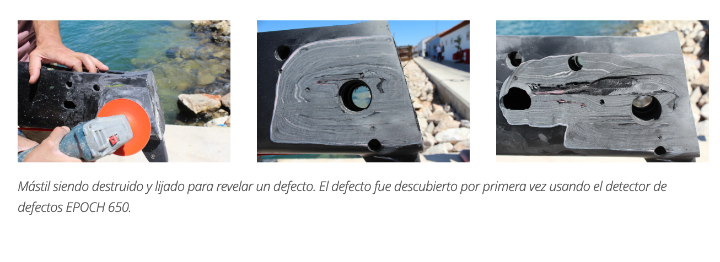
Cem recalled a previous inspection in which he had discovered delamination in a mast made of carbon composite material thanks to the EPOCH 650 defect detector. Cem reported this defect to the client, and based on the reputation of marineSOLUTIONS and Evident, the owner decided to conduct a destructive inspection of that yacht part. The destructive inspection of a carbon mast renders it irreparable and unusable.
"While the owner made [that] decision, it was quite stressful to witness the destructive inspection of a high-value carbon mast based on our findings. Nevertheless, we were confident in our expertise and the reliability of Evident equipment," Cem added.
The defect was found at the exact location that had been reported, and an additional inspection led to the discovery of a manufacturing defect. The inspection resulted in the replacement of the entire mast by the manufacturer, which was worth around $250,000.
The company marineSOLUTIONS continues to invest in Evident products. "We have never been disappointed with the support and reliability of [Evident] products in the field," Cem stated.
He added: "Evident's ultrasonic instruments provide reliable and unquestionable results. Evident is a well-established and renowned brand in the field of ultrasonic NDT. Our clients have relied on some of our ultrasonic findings to pursue claims in the courts of various countries around the world with replicable success."
Marketing Specialist, Portable NDT Instruments
Betsy has a technical sales and content marketing background. From 2020 to 2022, Betsy worked with Evident's portable nondestructive testing (NDT) portfolio of ultrasonic thickness gauges, flaw detectors, and their solutions. She holds a bachelor's degree and master's degree from Iowa State University of Science and Technology.