
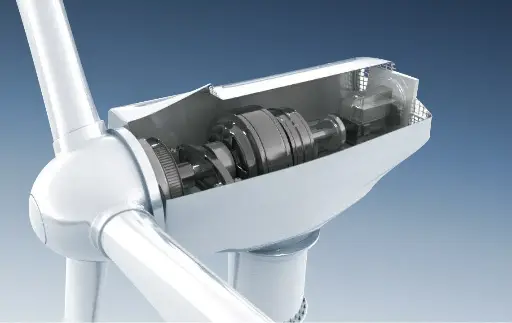
In the wind energy industry, the trend towards longer and lighter blades has pushed the properties of composite materials to their limits. The integrity of the adhesive bond between thespar capandthe shellis the heart of the blade's stability. A failure in this bonding not only reduces aerodynamic efficiency but also poses a risk of catastrophic collapse.
For integrity engineers and OEM manufacturers in Mexico, ensuring that there are no disbonds or excessive porosity is an absolute priority. AtZION NDT, we understand that the complexity of these materials requires technology that goes beyond conventional ultrasound. Therefore, theOmniScan X4is presented as the ultimate tool to raise quality standards in the plant and field.
Why do spar joints fail?
Modern wind turbine blades are massive engineering structures primarily made of glass fiber reinforced polymers (GFRP) or carbon (CFRP). The critical point is the interface where the spar distributes mechanical loads.
The physics of inspection in composites
Unlike metals, composite materials are anisotropic and highly attenuating to ultrasonic waves. Traditional methods often suffer from:
Beam dispersion: Structural noise makes it difficult to distinguish between a healthy bond and a disbond.
Complex geometries: The blade's curvatures create dead zones if the proper coupling is not used.
The implementation ofPhased Array Ultrasonic Testing (PAUT)allows mitigating these effects through electronic control of the angles of incidence and focusing the energy at the exact depth of the joint line.
OmniScan X4:
Evolución en la detección de despegues
TheOmniScan X4is not just a higher resolution device; it is a platform designed for the workflow of modernNon-Destructive Testing (NDT).
Applications and Use Cases
Manufacturing Validation (OEM): Post-infusion inspection to detect adhesion failures or air inclusions before the blade leaves the production line.
Preventive Maintenance (O&M): Monitoring crack progression in the Shear Web joint during maintenance campaigns in operational wind farms.
Third-Party Audits: Certification of structural repairs after lightning strikes or material fatigue.
Compliance with International Standards
The use of the OmniScan X4 facilitates compliance with rigorous standards such as:
ISO 10868: Non-destructive testing for the wind industry.
ASTM E2580: Standard practice for ultrasonic examination of aerospace composite materials (applicable by analogy to wind energy).
DNV-ST-0376: Certification standard for wind turbine blades.
How does PAUT technology and RollerFORM scanning work in the OmniScan X4?
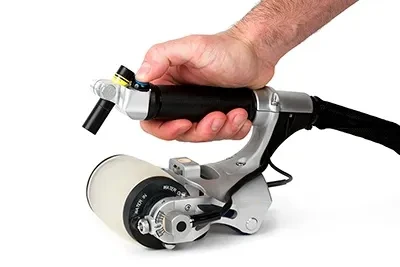
The key differentiator for blade inspection is the integration of the RollerFORM scanner with the processing power of the OmniScan X4.
The RollerFORM is a soft rubber wheel filled with liquid that acts as a dry couplant. As it glides over the surface of the blade, it allows for consistent coverage without the need for massive supplies of water or gel, which is critical when working at height or in clean manufacturing environments.
The OmniScan X4 uses next-generationTFM (Total Focusing Method). While conventional PAUT focuses on one area, TFM processes information from all transducer elements simultaneously, creating an image with uniform resolution throughout the depth of the spar joint. This allows for the identification of micro-separations that were previously invisible.
OmniScan™ X4
Reduce inspection timeswith a data transfer speed
Phased Array + PCI
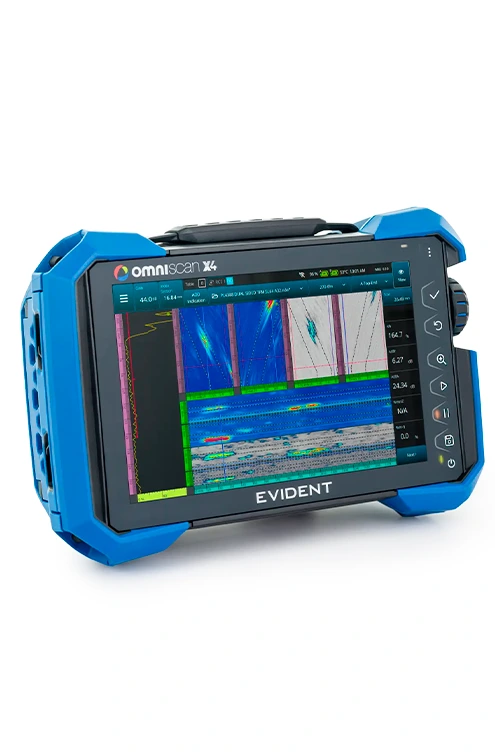
Complex Defect Analysis
Technical Comparison:
Traditional Inspection vs. OmniScan X4 Ecosystem
Characteristic | Conventional Ultrasound (UT)) | OmniScan X4 + RollerFORM (PAUT) |
Scanning Speed | Slow (point-to-point) | High (continuous area mapping) |
Probabilidad de Detección (POD) | Medium (depends on the operator) | Very High (real-time C-Scan images) |
Data Record | Manual / Brief reports | Fully digital (100% traceability) |
Ease of Use | Requires constant couplant | Optimized dry coupling |
Interpretation | A-Scan Signal Interpretation | Intuitive Visualization of Joint Integrity |
The ZION NDT Recommendation: For quality managers looking to reduce inspection times by 40%, we recommend transitioning to corrosion mapping systems and PAUT-based compounds. The return on investment is seen not only in speed but also in the elimination of "false positives" that delay the delivery of blades.
Frequently Asked Questions (FAQs)
1. Is it necessary to use liquid coupling with the RollerFORM?
Although the RollerFORM is designed to minimize the use of couplants, a small amount of water or wetting agent improves signal quality on very rough blade surfaces.
2. Can the OmniScan X4 detect delaminations in carbon fiber (CFRP)?
Yes. Thanks to its wide dynamic range and adjustable frequency filters, it can penetrate carbon layers that are typically more conductive and difficult to inspect than fiberglass.
3. What level of certification does the inspector need to operate this equipment?
It is recommended that personnel have Level II in PAUT according to SNT-TC-1A or ISO 9712 to ensure correct interpretation of the collected data.
4. Is the equipment durable for working in wind farms in Mexico?
Absolutely. The OmniScan X4 has an IP65 certification, which protects it from desert dust and humidity in coastal areas where the country's main parks are located.
5. Can the data be exported for remote analysis?
Yes, the software allows for the export of raw data files so that integrity engineers can perform secondary analysis in the office without needing to be on site.
The safety of a wind farm begins with the integrity of its components. Investing in ZION NDT technology and the OmniScan X4 ensures that every blade spinning in the Mexican sky does so with the certainty of a perfect bond. We don't just sell equipment; we provide the ability to make decisions based on indisputable technical data.
Equipo relacionado
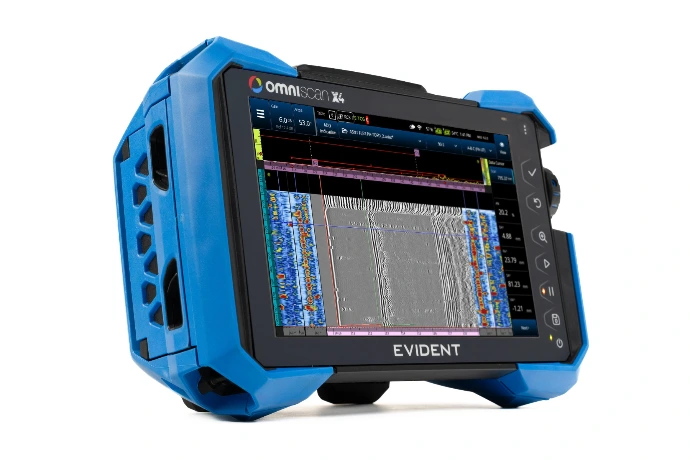
OmniScan X4
El detector OmniScan™ X4 combina capacidades multitecnológicas y un procesamiento de datos de alta velocidad en una unidad potente. Gracias a su versatilidad en Phased Array y sus modos TFM y PCI, tiene un rendimiento excepcional.