
In the railway industry, structural integrity is non-negotiable. The axle center is one of the most critical areas, subjected to constant loading and unloading cycles that can lead tofatigue cracks. Traditionally, inspecting these areas involved a costly and slow process: removing protective coatings or paint to allow techniques such as magnetic particles or penetrant liquids.
AtZION NDT, we understand that every hour a railcar spends in the shop represents a loss of competitiveness. Therefore, the implementation ofEddy Currents (ECT)is presented as the modern standard, allowing for adequate detection without the need to damage or remove the paint layer, ensuring the operational continuity of fleets in Mexico and around the world.
How do Eddy Currents work
on the surface of the shaft?
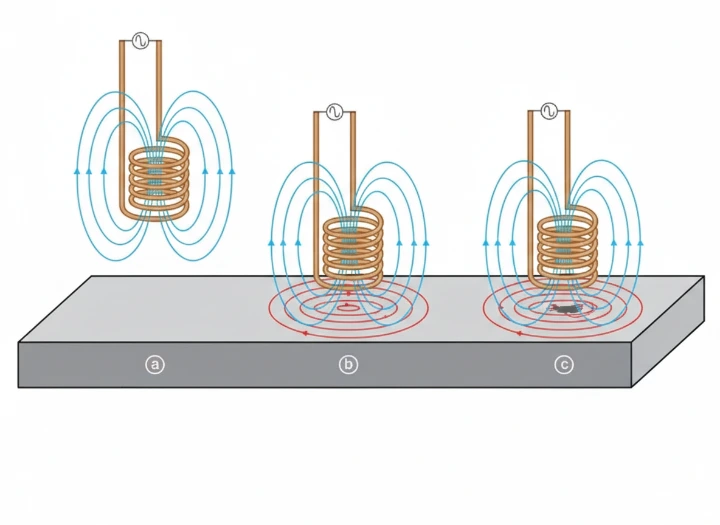
The technique ofEddy Currentsis based on the principle of electromagnetic induction. A coil excited with alternating current generates a magnetic field that, when approaching the conductive shaft (steel), induces circular currents (eddy currents).
When there is a discontinuity, such as a fatigue crack, the flow of these currents is interrupted, altering the impedance of the coil. This variation is detected by the equipment and translated into a visual signal. The revolutionary aspect of the systems we integrate at ZION NDT is their ability to penetrate non-conductive coatings (paint or grease) several millimeters thick, while maintaining exceptional sensitivity to detect subsurface defects.
Applications
Manual inspection can be erratic. Therefore, we recommend using the coil probe. This device maintains a constant coupling and a controlled lift-off distance from the surface of the axle.
In the logistics sector of Bajío: Where automotive load movement is incessant, reducing inspection time from 4 hours to 30 minutes per axle by using specialized probes drastically changes the flow of the workshop.
Railway preventive maintenance: Allows for quick scans at the axle center during routine checks, without waiting for the axle to be sent for deep cleaning.
Compliance with International Standards
Our solutions are designed to help inspectors meet the most rigorous standards, such as:
Nortec 600
The Evident Nortec® 600 combines advanced digital circuits and fault detection in a portable and rugged unit, featuring its high-visibility VGA display that ensures clear signals under any lighting.
Why do Eddy Currents
outperform traditional methods?
The true technical differentiator lies in the management of lift-offand the operating frequency.While conventionalultrasoundrequires a liquid couplant and total stripping, ZION NDT's Eddy currents use signal compensation algorithms. This means that the equipment can distinguish between noise caused by the thickness of the paint and the actual signal of an incipient crack.
For an Integrity Engineer, this translates into pure data: we can detect cracks of just a few microns deep before they become catastrophic failures, all while the shaft retains its intact corrosion protection.
Variable | Magnetic Particles - MT | Ultrasound - UT | Eddy Currents - ECT |
Surface Preparation | Requires total stripping (chemical/mechanical cleaning). | Requires cleaning and couplant. | Minimal (inspect over paint/grease). |
Inspection Time | High (cleaning + application + post-cleaning). | Medium. | Very Low (quick scan). |
Crack Sensitivity | Only surface. | Excellent for internal defects. | Excellent for surface fatigue cracks. |
Operating Cost | High (consumables and labor). | Medium (requires highly trained personnel). | Low (no consumables, high speed). |
It is not about replacing Ultrasonics, but rather complementing it. We recommend using Eddy Currents as the first line of defense in preventive maintenance to filter healthy shafts from suspicious ones on a large scale, leaving UT for the characterization of deep internal defects.
Railway axle inspection is evolving. Moving away from paint stripping is not just a savings in chemicals and time; it is a strategic decision that extends the lifespan of assets and ensures the safety of the tracks. AtZION NDT, we position ourselves as your ally to integrate these cutting-edge technologies into your maintenance protocols.
Do you want to see how Eddy Currents can transform your delivery times?At ZION NDT, we offer personalized technical advice and field demonstrations so you can verify the accuracy of our equipment in your own facilities.
Frequently Asked Questions (FAQs)
1. ¿Realmente puede detectar grietas a través de 2mm de pintura?
Sí. Los equipos de ZION NDT están calibrados para compensar el efecto de lift-off provocado por recubrimientos no conductores, manteniendo la sensibilidad necesaria para hallar fatiga en el acero base.
2. ¿Qué pasa si el eje tiene mucha grasa o suciedad?
A diferencia de los líquidos penetrantes, el ECT no requiere una superficie estéril. Siempre que la sonda pueda desplazarse físicamente de forma estable, la suciedad no conductora no afecta la detección.
3. ¿Es necesario que el inspector sea Nivel III para operar estos equipos?
Si bien la interpretación final de datos complejos requiere certificación, el software intuitivo facilita escaneos nivel II mediante alarmas configurables. Para dominar la interpretación de datos complejos, aproveche la experiencia técnica de nuestros Cursos de Pruebas No Destructivas y potencie su carrera.
4. ¿Cómo afecta la curvatura del eje a la lectura?
Nuestras sondas de rueda y palpadores flexibles están diseñados ergonómicamente para adaptarse a la geometría cilíndrica del cuerpo central del eje, asegurando un contacto uniforme.
5. ¿Qué durabilidad tienen estos equipos en ambientes industriales como el norte de México?
Nuestros equipos cuentan con certificaciones IP65/IP67, lo que significa que están protegidos contra el polvo fino del desierto y la humedad extrema, garantizando que la inversión de ZION NDT rinda por años.
Equipos relacionados
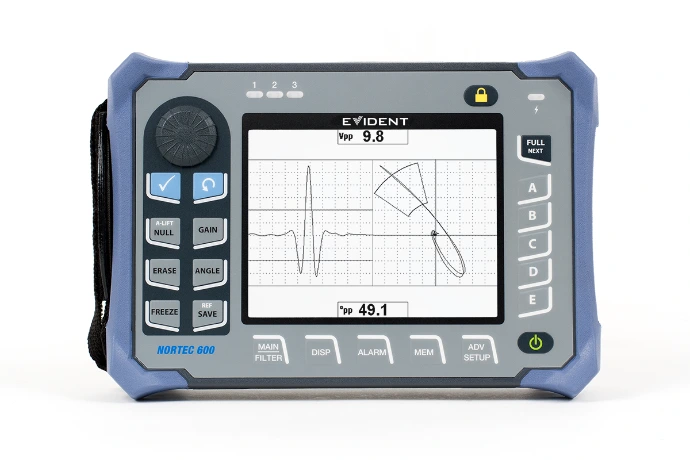
El detector de defectos Nortec® 600 integra circuitos digitales de alta gama y una avanzada tecnología de corrientes de Foucault en una unidad portátil, compacta y resistente. Gracias a su pantalla VGA de 5,7 pulgadas y su modo de pantalla completa, proporciona señales de gran nitidez y un contraste excepcional bajo cualquier condición de iluminación.
El detector de defectos Nortec® 600 integra circuitos digitales de alta gama y una avanzada tecnología de corrientes de Foucault en una unidad portátil, compacta y resistente. Gracias a su pantalla VGA de 5,7 pulgadas y su modo de pantalla completa, proporciona señales de gran nitidez y un contraste excepcional bajo cualquier condición de iluminación.